
A deep dive into the thousand-year history of India’s most sacred folk art — by the team at Janijatra, a heritage brand from Odisha.
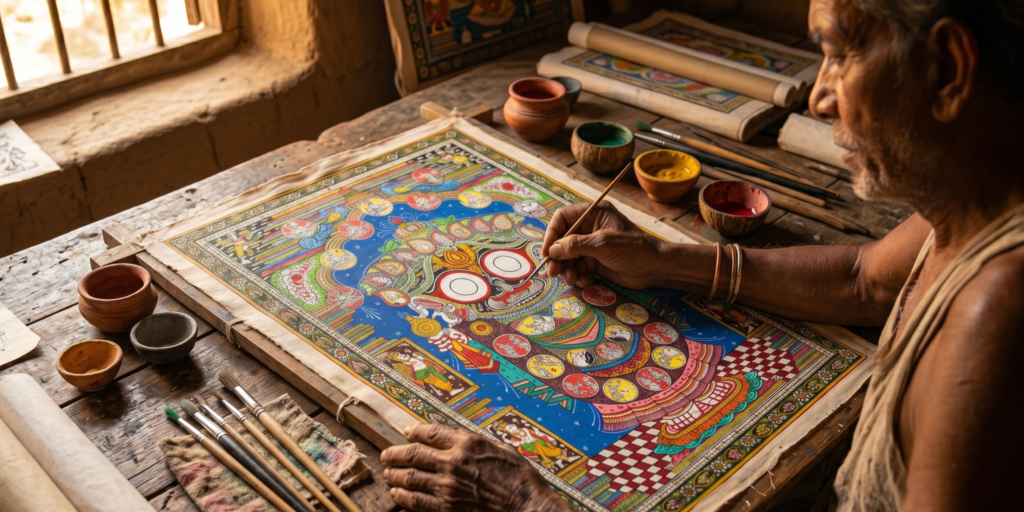
There is a sound you can still hear in a corner of Puri district, if you know where to listen. It is the sound of an iron stylus meeting a dried palm leaf — a soft, dry scratch, almost like a beetle moving across paper. The man holding the stylus is a *chitrakara*, a painter, and he is doing what his great-great-grandfathers did before him. He is not making art. He is performing an act that, in Odisha, has been considered a form of worship for nearly a thousand years.
This is Pattachitra. And its history is far stranger, far older, and far more sacred than the gift-shop label on most paintings would suggest.
What “Pattachitra” Actually Means
The word comes from two Sanskrit roots — patta, meaning cloth, and chitra, meaning picture. A picture on cloth. That is the literal translation, and it is also the most misleading part of the name.
Because Pattachitra is not really one art form. It is three, practised by the same families, with the same eye, the same pigments, the same gods, but on three completely different surfaces.
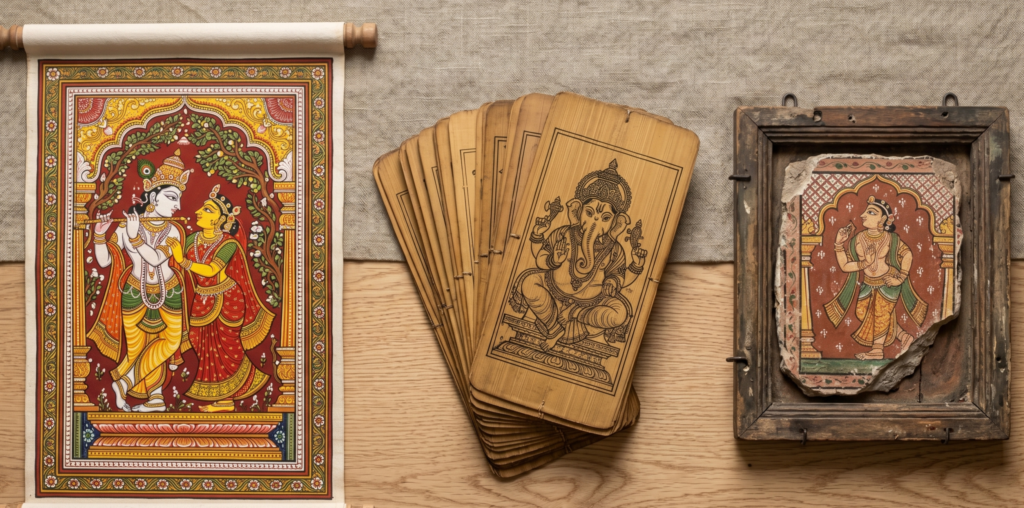
- Patta Chitra – painting on prepared cotton cloth. This is what most people see in galleries and online stores.
- Bhitti Chitra – mural painting on the walls of homes and temples. Older than cloth, and quietly disappearing.
- Tala Patra Chitra (also called Pothi Chitra) – engraving on dried palm leaves with a metal stylus. Older still. The closest living descendant of India’s manuscript tradition.
All three are Pattachitra. All three are made by the same hereditary community of painters known as chitrakaras. And all three originate, almost without exception, in a single temple — the Jagannath temple in Puri.
Before Pattachitra Was Pattachitra
To understand where Pattachitra came from, you have to look at the stone first.
By the 11th century, the Kalinga style of temple architecture had already reached its full expression in Odisha. The Lingaraja temple in Bhubaneswar, the Mukteswar, the Parsurameswar, and shortly afterwards the great Jagannath temple of Puri and the Sun Temple at Konark — these were not just buildings. They were vast outdoor manuscripts of stone. Every wall carried gods, dancers, lovers, processions, animals, geometric borders, lotus motifs. Look at the female figures on the Konark walls and you will see exactly the same elongated eyes, the same gracefully arched torsos, the same curving fingers that you see in any Pattachitra painted today. The painters did not invent this style. They inherited it from the sculptors.
In parallel, Odisha had become one of the great manuscript-producing regions of India. The Odia script — rounded, with no sharp horizontal strokes — was literally shaped by the technology that recorded it. A straight line on a palm leaf would split the leaf along its grain; a curve would not. So the script evolved to match the leaf. And the leaf, in turn, was used to record everything: epics, horoscopes, medical treatises, royal decrees, the Bhagavata, the Gita Govinda of the poet Jayadeva. Scribes began illustrating their texts with small line drawings of the deities being described. The hand that wrote the verse began to draw the god. That is where Tala Patra Chitra was born — in the margins of a manuscript, several centuries before anyone called it art.
So when Pattachitra finally appears on cloth, somewhere between the 11th and 13th centuries, it is not an invention. It is the meeting point of two older streams: the visual language of Kalinga temple sculpture, and the practical craft of palm leaf inscription.
What gave it a centre — and a reason to exist — was Jagannath.
The Jagannath Temple, and the Painters Who Served It
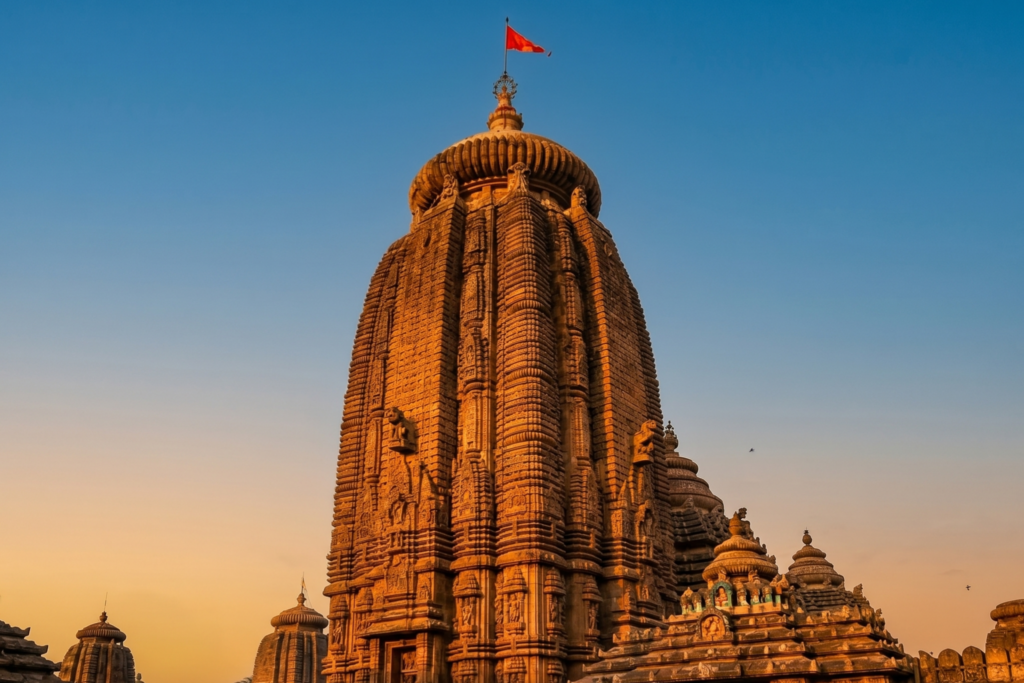
In 1135 CE, the Eastern Ganga king Anantavarman Chodaganga Deva began construction of what would become the Jagannath temple at Puri. It was finished in the 12th century, and it changed everything. The temple became one of the four sacred dhamas of Hindu pilgrimage, drawing devotees from every corner of the subcontinent. With the pilgrims came an economy — and inside that economy, the chitrakaras found their permanent role.
They served the temple in three ways. They painted ritual images of Jagannath, Balabhadra, and Subhadra for pilgrims to take home. They decorated the temple’s wooden chariots and ceremonial objects during festivals. And most importantly, they painted the substitute deities used during Anasara — a ritual so unusual that, even today, very few people outside Odisha know it exists.
The Anasara Secret: Pattachitra’s Sacred Origin
Every year, in the lunar month of Jyestha (May–June), Lord Jagannath, Balabhadra, and Subhadra are given a ceremonial bath in 108 pots of water during Snana Yatra. The bath, by tradition, causes the deities to fall ill. They are taken away from public view and confined to a private chamber called the Anasara Ghara for fifteen days, recuperating, until they re-emerge for the famous Rath Yatra in Ashadha.
But the temple cannot be empty of gods for fifteen days. Pilgrims still come. Worship still happens.
So in the place of the wooden deities, three paintings are installed — Anasara Pati — depicting Jagannath as Sri Ananta Narayana, Balabhadra as Sri Ananta Vasudeva, and Subhadra as Devi Bhubaneswari. These paintings are not decoration. They are, ritually, the gods themselves for those fifteen days. They are bathed, dressed, fed, and worshipped exactly as the wooden idols would be.
The Anasara Pati are painted by a specific lineage of chitrakaras under strict conditions of purity, beginning on Jyestha Amavasya. A team of ten to fifteen painters works under a master artist. The cloth comes from the temple itself. The work usually takes about fifteen days. And when the wooden deities re-emerge for Rath Yatra, the Anasara Pati are retired with reverence.
This is the religious origin of Pattachitra. The art form did not begin as decoration. It began as a stand-in for divinity. To this day, when a chitrakara in Raghurajpur paints Jagannath onto cloth or palm leaf, there is a thread — literal and unbroken — connecting his brush to the Anasara tradition at Puri.
If you want to see this living connection between art and worship, watch the [Jagannath Pattachitra reel on our Instagram](https://www.instagram.com/janijatra.com_/reel/DWk33H2yMOV/). The same lines, the same eyes, the same iconography — painted today, exactly as they would have been seven hundred years ago.
The Chitrakaras: A Community Built Around the Brush
The painters of Odisha were never freelance artists. They were a hereditary community, organised by lineage, marriage, and geography. Their households were workshops; their workshops were temples. The men drew the initial outlines and gave the final finishing strokes. The women prepared the canvas, ground pigments, filled in colours, and applied the protective lacquer coat. Sons learned from fathers; daughters-in-law learned from mothers-in-law.
The major painter settlements developed in what came to be called chitrakara sahis — painter quarters. The most famous of these is Raghurajpur, twelve kilometres north of Puri, on the banks of the Bhargavi river. Founded, by local tradition, during the reign of the 13th-century Eastern Ganga king Narasingha Deva I, Raghurajpur has roughly 120 households today and almost every single one of them is engaged in some form of the craft. There are also chitrakaras in Dandasahi, in Chitrakarasahi within Puri town, in Paralakhemundi, Chikiti, Digapahandi, and in tucked-away villages like Nayak Patna and Andhia Sahi where the rarer Pothi Chitra form of palm leaf engraving has survived.
These communities did not just preserve a technique. They preserved a way of seeing.
How a Pattachitra Is Actually Made
This is the part most articles skip. It is also the part that separates a real Pattachitra from a printed reproduction.
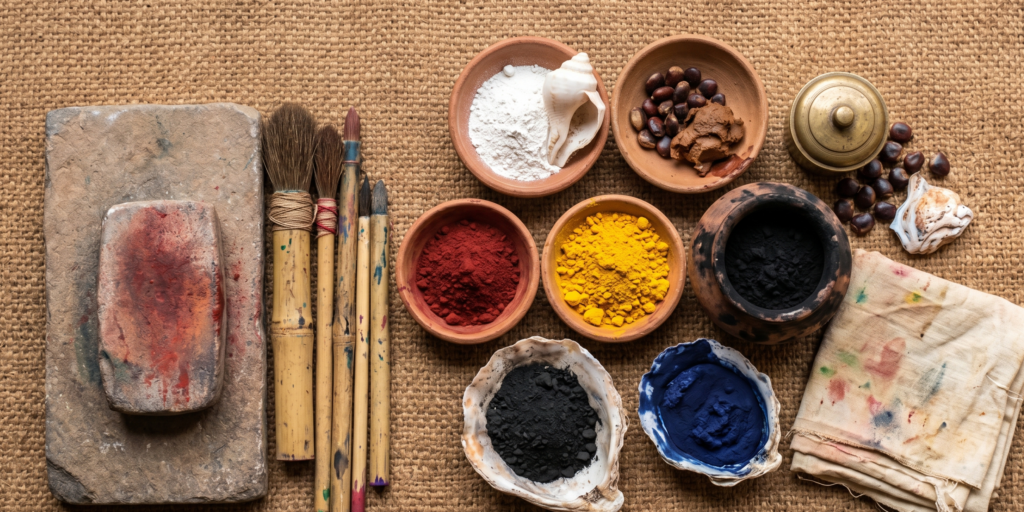
The canvas (patta). Two layers of soft cotton cloth — often old, washed cotton saris that have lost their starch — are bonded together with a paste called niryas kalpa To make niryas kalpa, tamarind seeds are soaked for three days, then pounded into pulp and slowly cooked in an earthen pot until the mixture thickens into a glue. Conch-shell powder or chalk is added to give body. The paste is spread between the two cloth layers. Once dry, the cloth is rubbed against two stones — a rough one and a smooth one (sometimes called khaddar stones) — until the surface acquires a leather-like sheen that can hold paint without bleeding.
The pigments. Every traditional Pattachitra colour is mineral, vegetable, or shell-based.
- White – powdered conch shell.
- Blackm- lamp-black, made by burning coconut shells or oil lamps and collecting the soot.
- Red – hingula, a vermilion derived from cinnabar.
- Yellow – haritala, a natural arsenic compound.
- Indigo – from the indigo plant.
There is no blue beyond indigo in the older palette. No green that isn’t mixed from yellow and indigo. The chitrakaras of Raghurajpur still grind these pigments by hand on a flat stone, mixing them with a little of the same tamarind glue used for the canvas.
The brushes. Tied bundles of squirrel hair, goat hair, or mongoose hair, fastened to the tip of a thin bamboo stick. Each chitrakara typically makes his own brushes. There is no pencil, no charcoal, no preliminary sketch — the master painter draws the figure directly onto the prepared canvas with a thin red or yellow line, freehand.
The finishing. Once painting is complete, the cloth is held over a small fire and brushed on the reverse with a natural lacquer. The heat sets the lacquer and fixes the colours. The result is a painting that, properly cared for, will outlive its owner by generations.
This is not decorative craft. It is chemistry, biology, geometry, ritual, and inheritance, performed by hand, in a small home, by people whose families have been doing it since before the Mughals arrived in India.
The Three Forms in Depth
Patta Chitra (cloth)
The largest and most flexible form. Patta Chitra paintings are made in scroll formats, in square panels, in long horizontal “story” strips, and even on saris and folding screens. The classical iconographic conventions are strict: elongated eyes, no perspective, no landscape backgrounds, all figures in close juxtaposition, a mandatory floral or geometric border framing the composition. A trained eye can identify a chitrakara’s lineage by the way he draws the eye alone.
Bhitti Chitra (wall)
The least commercial and the most quietly endangered form. If you walk through Raghurajpur today, you will see Bhitti Chitra on the outer walls of the painters’ own homes — scenes from the Ramayana, the Krishna Leela, wedding processions, ornamental borders. These were once painted in every chitrakara household, repainted before festivals, repaired after monsoons. Most are now done in modern paint, and only a few elders remember the older mineral-pigment technique. This form survives almost entirely because of tourism.
Tala Patra Chitra (palm leaf)
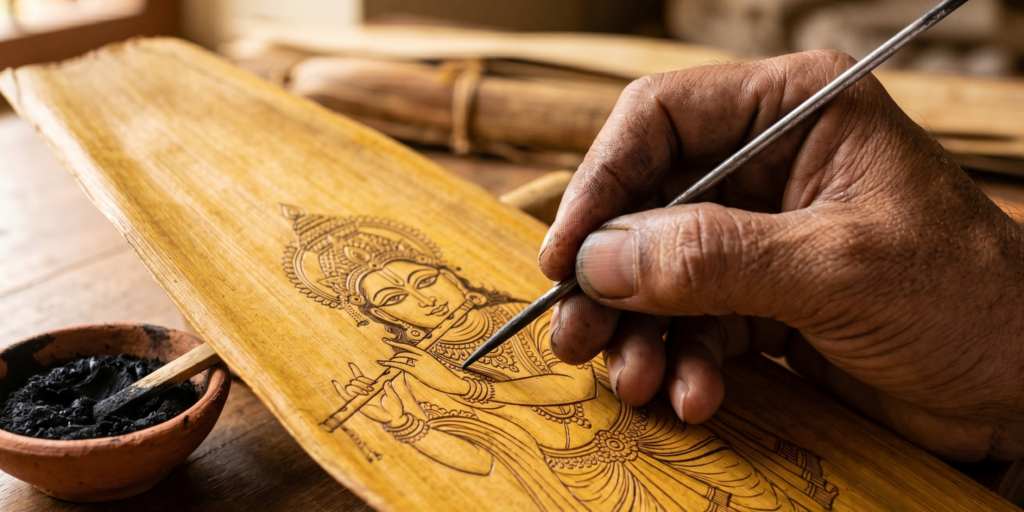
The oldest, rarest, and most technically demanding of the three. The leaves are taken from the tall Tala palm that grows along the Odisha coast — collected by members of the Pothi community, who climb the tree and cut the branches. The leaves are sun-dried for two to three months, then treated with a turmeric-water solution. The turmeric does two things: it gives the leaves a pale-golden hue, and its antimicrobial properties prevent decay. A well-made Tala Patra panel can last *six hundred years*. There are palm leaf manuscripts in the Odisha State Museum at Bhubaneswar that are older than the United States.
The leaves are cut into uniform strips, stitched together with cotton thread passing through their centres so they can fold up like a fan. The chitrakara then engraves his image with a sharp iron stylus called a *lekhani*, working without preparatory sketches. Once the engraving is done, he rubs a paste of lamp-black and oil into the grooves, then wipes the surface clean. The black settles into the engraved lines and the image emerges. Some chitrakaras add light colour washes afterwards; the more orthodox keep it strictly black and gold.
This is the form Janijatra works most closely with. Pieces like the [Jagannath Balabhadra Subhadra Palm Leaf Art](https://janijatra.com/product/jagannath-balabhadra-subhadra-palm-leaf-art-tala-patra-chitra-wall-hanging/), the [Bal Krishna Makhan Chori Tala Patra](https://janijatra.com/product/bal-krishna-makhan-chori-palm-leaf-art-tala-patra-chitra-wall-hanging/), and the [Standing Vishnu Palm Leaf Engraving](https://janijatra.com/product/standing-vishnu-palm-leaf-art-traditional-tala-patra-chitra-wall-hanging/) are made by chitrakaras following exactly the technique described above, in the same villages, with the same materials. Odisha is the only state in India where this nine-hundred-year-old technique is still being practised commercially. That fact alone is worth pausing on.
Themes: What the Chitrakaras Paint
The subject matter of Pattachitra is not random. It is canonical — drawn from a relatively fixed list of religious and mythological themes that have been painted, repainted, and re-imagined for centuries.
The most common subjects are:
- The Jagannath trinity – Jagannath, Balabhadra, and Subhadra, often shown alongside Sudarshan, framed by the symbols of the Puri temple.
- Krishna Leela – episodes from Krishna’s childhood and youth: Makhan Chori (the stealing of butter), Kaliya Damana (the subduing of the serpent Kaliya), the Rasa Leela with the gopis.
- Dashavatar – the ten incarnations of Vishnu, arranged in a long horizontal frieze.
- Rama Lila – the great scenes from the Ramayana.
- Tantric and esoteric subjects – including the rare Ucchishta Ganapati, depicted in works like this [Tantric Ucchishta Ganapati Palm Leaf Art](https://janijatra.com/product/tantric-ucchishta-ganapati-palm-leaf-art-rare-ganesha-tala-patra-wall-hanging/).
- Gita Govinda episodes – the verses of Jayadeva’s 12th-century lyrical poem, painted as visual sequences. The [Gopa Rasa Leela horizontal Pattachitra](https://janijatra.com/product/gopa-rasa-leela-tala-pattachitra-horizontal-palm-leaf-art-from-odisha/) is a classic example of this genre.
What you will almost never see in a true Pattachitra is a landscape, a distant horizon, or a portrait of a real living person. The chitrakara paints the eternal. Everything else is, by tradition, considered beneath the form.
The Dark Years
It would be misleading to tell this history as an unbroken triumphant arc. It was not.
By the late 19th and early 20th centuries, the Pattachitra tradition was in serious trouble. The Eastern Ganga and Gajapati patronage was long gone. The temple economy that had sustained the chitrakaras was shrinking. Colonial-era exports of cheap printed lithographs — the famous Ravi Varma prints among them — flooded Indian markets and undercut the painters. By the 1950s and 1960s, many chitrakaras in Raghurajpur and elsewhere had given up the brush altogether. They became farmers. Their children went to school and learned other trades. The wall murals stopped being repainted. The pigment stones gathered dust.
If you had walked through Raghurajpur in 1970, you might have seen the last generation of practising masters and not known you were looking at the end of a tradition.
The Raghurajpur Revival
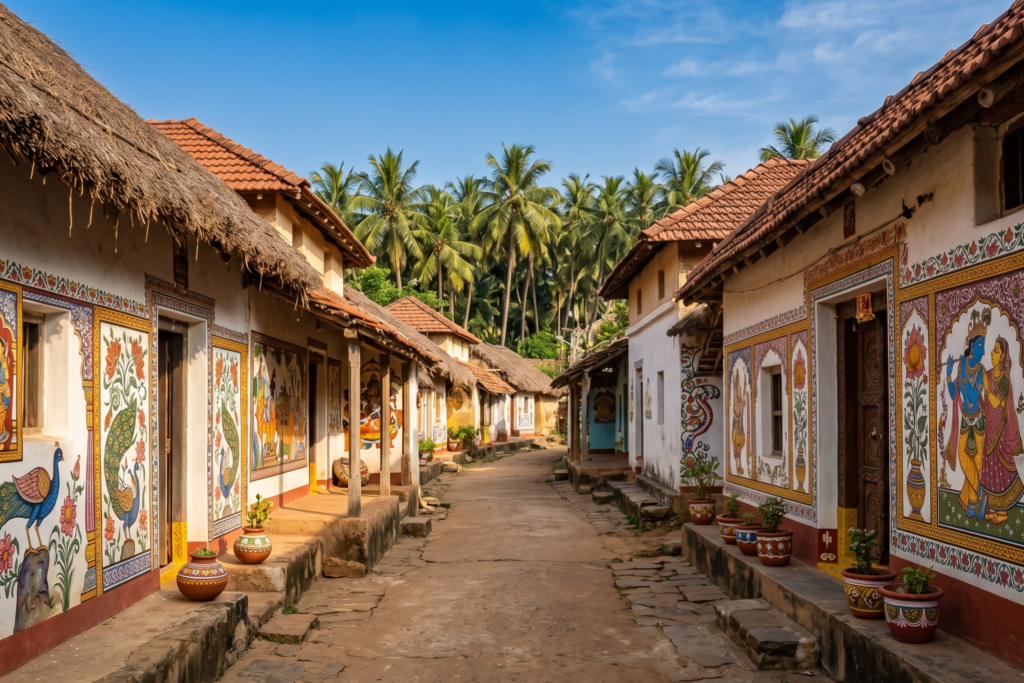
The revival began, slowly, in the 1980s, but the decisive moment came in 1998. The Indian National Trust for Art and Cultural Heritage (INTACH) began a two-year documentation project in Raghurajpur. They mapped the village, interviewed every surviving chitrakara, recorded the techniques, the pigments, the lineages. In 2000, Raghurajpur was declared India’s first “Heritage Crafts Village” — a designation that brought infrastructure, tourism, and, most importantly, a sense that the work was nationally valued.
Then in March 2008, the Pattachitra art of Raghurajpur received a Geographical Indication (GI) tag — a legal protection that means a painting can only be labelled “Raghurajpur Pattachitra” if it is actually made there, by these chitrakaras, in this way. The GI tag did for Pattachitra what an Appellation d’Origine Contrôlée did for French wine: it set a floor of authenticity in a market drowning in cheap reproductions.
Today, Raghurajpur is an open-air museum. Walking through the village means walking past 120-odd houses whose outer walls are themselves murals. Inside each house, families are painting. Tourists come from Delhi, from Mumbai, from France, from Japan. The annual Basant Utsav – Parampara festival, held every February–March since 1993, brings dancers and artists to the village. Even the old Gotipua dance tradition, once on the brink of extinction here, has been revived — Raghurajpur was, after all, the birthplace of the great Odissi dancer Guru Kelucharan Mohapatra.
Pattachitra in the World Today
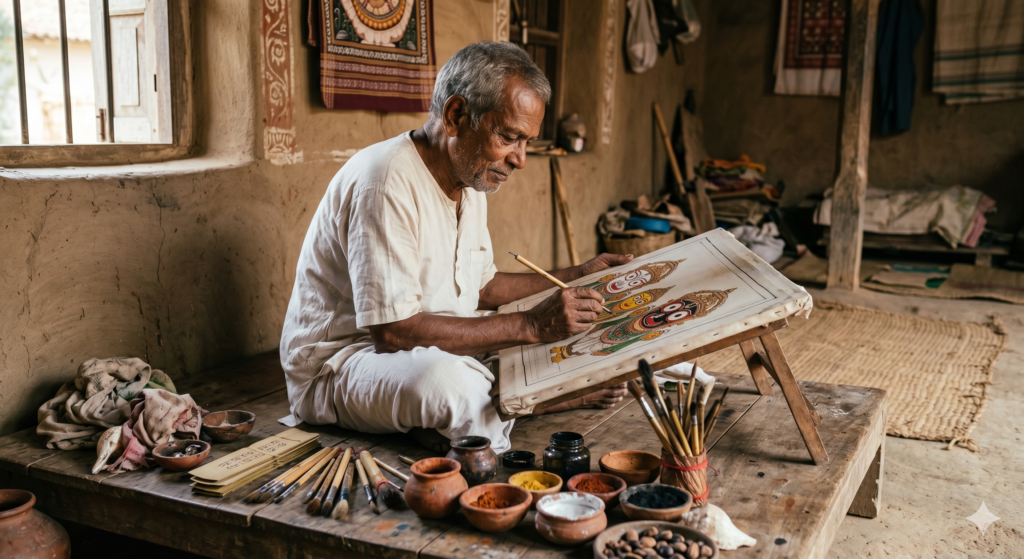
The contemporary Pattachitra scene has its stars. Anant Moharana, a National Award-winning master from Raghurajpur, draws on palm leaves with a precision that has been compared to medieval European illumination. Bijaya Parida is known for his richly coloured Tala Patra fans (pankha), one of which is on permanent display at the ODIART Purvasha Museum on Chilika Lake. Jagannath Mahapatra and his family have been documented by The Federal, Outlook, and the BBC. In 2012, when Prime Minister Narendra Modi gifted a Pattachitra painting to French President François Hollande, the form crossed permanently from the realm of “Indian handicraft” into the world of recognised diplomatic art.
International galleries in London, Paris, and Tokyo now exhibit Pattachitra alongside contemporary Indian fine art. Auction houses have begun to list pieces from named masters. Younger chitrakaras — some of them women, in a craft historically dominated by men — are studying at art schools and bringing the visual language of Pattachitra into illustration, fashion, animation, and digital design.
And yet. The masters still live in the same village. They still grind pigment by hand. They still draw without a pencil. The line from Anantavarman Chodaganga Deva’s 12th-century temple to a chitrakara’s brush in 2026 has never actually broken. That, more than anything, is what Pattachitra is.
Why This Matters — and What Janijatra Stands For
We started Janijatra in Odisha for one reason: this art is not a museum piece. It is a living tradition, made by living people, in living villages, and it survives only as long as someone is willing to buy what they make at a price that lets them keep making it.
Every Pattachitra and every Tala Patra Chitra at Janijatra is sourced directly from chitrakara families working in the lineage described in this article. We do not sell prints. We do not sell machine reproductions. Every piece carries the hand of a named artisan, the natural pigments described above, and the centuries-old iconography of the Jagannath cult and the Krishna leela.
If you are thinking about owning a piece, start with our [Jagannath Pattachitra collection](https://janijatra.com/product/jagannath-balabhadra-subhadra-palm-leaf-art-traditional-odisha-tala-patra-wall-hanging/) — the form closest to the Anasara tradition this whole story began with. Or browse the [Krishna and Vishnu palm leaf collection](https://janijatra.com/product/standing-vishnu-palm-leaf-art-traditional-tala-patra-chitra-wall-hanging/) for the more lyrical, Gita Govinda-inspired works.
When you hang a Pattachitra on your wall, you are not buying decor. You are extending a thousand-year-old chain by one more link. That is the only reason this art still exists, and that is the only reason it will continue to exist.
Further reading and sources
- INTACH – (Indian National Trust for Art and Cultural Heritage) — [intach.org](https://www.intach.org)
- Odisha Tourism – Festivals & Crafts — [odishatourism.gov.in](https://odishatourism.gov.in)
- Crafts Council of Odisha – [craftsodisha.org](https://www.craftsodisha.org/)
- GI Registry of India – Raghurajpur Pattachitra, GI Application No. 95, granted 2008
- Das, J. P. Puri Paintings: The Chitrakara and His Work (Arnold-Heinemann, 1982).
- Mohapatra, J. Pattachitra Paintings of Orissa (Orissa Lalit Kala Akademi).
Written by the team at Janijatra. We are a heritage brand from Odisha working directly with chitrakara families of Raghurajpur, stone-carvers of Lalitgiri, and brass artisans of the Mahanadi delta. To explore our complete collection of handcrafted divine art, visit [janijatra.com](https://janijatra.com).